Saturday, December 14, 2013

Initiating the BPI Project

Description

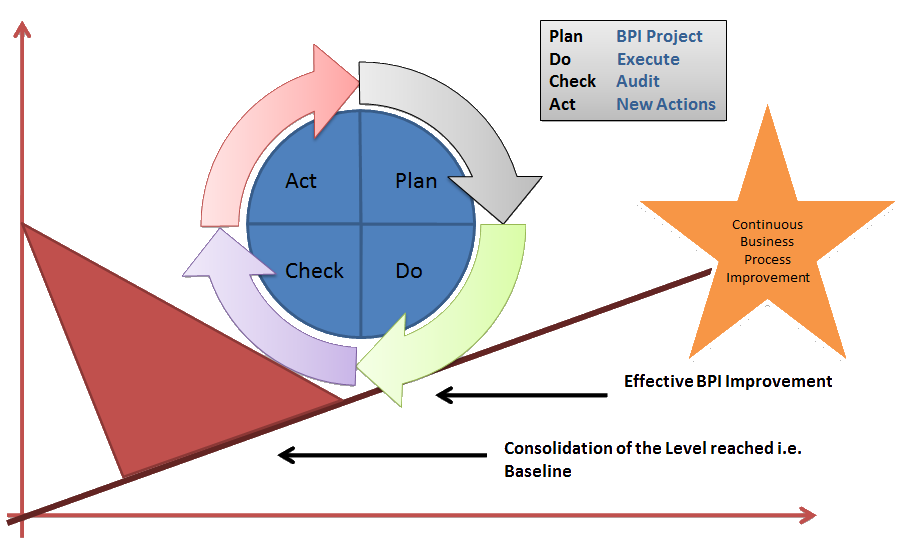
In the previous Blog “Case for Change” the emphasis was on justification, motivation and requisition for embarking on a Business Process Improvement. Most projects are launched to solve a specific shortcoming in a department or as part of a Six Sigma, Lean or Financial initiative that often does not take into account the impact of change on the downstream and upstream processes. In a previous BLOG, I shared with you a procedure that I use in Sales, that is based on the premise that “pain flows through the entire organisation”. This is an important concept when developing a BPI programme. With this in mind before embarking on a BPI project we consider initially the whole organisation to create a baseline and then proceed by applying the PDCA cycle during process execution. Once we have identified an issue in the “check segment of the PDCA cycle” the  Pain Chain Analysis is applied providing a means to identify the chain of events within an end to end process that impacts all who are involved in the process.

Creating the Initial Baseline

To create the baseline we need to collect information on the current in use processes, organisation, the aspirations of the management and the issues they have identified that are prohibiting them from realising their goals.There are a number of methods that can be used to establish a baseline.
  1. Build a holistic business model. This has be discussed in Entity Business Modeling Part 1 and Part 2
  2. Carry out a Quick Business Process Maturity Assessment to assess the acceptance of the BPI programme across the Organisation.
  3. Establish a Budget for the Programme and timeline based a list of priorities
  4. Analyse the organisation on how responsibility is assigned and performance assessed
  5. High level assessment of the IT Infrastructure and review gaps in its capability to manage, monitor and measure the key business end-to-end processes.
  6. Carry out a competitive analysis with organisations in similar industries and markets.
    1. Financial
    2. Products
    3. Customers and Suppliers
    4. etc.
  7. Select Methodologies and Architecture Models required to manage the programme lifecycle
  8. Establish roles and responsibilities required to manage and execute the programme and projects

Suggested steps


  • Meet with CEO and other senior executives to discuss business issues.
  • Review company’s competitive position and key business problems.
  • Obtain agreement on who needs to be involved in the process.
  • Design a workshop to facilitate the development of a case for change.
  • Pre-interview a representative sample (at least) of the leadership team.
  • Conduct the workshop.
  • Debrief the leadership team.
  • Formalise the Case for Change and communicate it throughout the organisation

The Value Proposition

 The Value Proposition

In many of the Business Process Projects I have been involved in, the project owners have been at the Division or Department level. This often presents a problem when developing business processes as there is no clear understanding of how they impact the Resource and Profit Models and ultimately the organisations ability to fulfill its Value Proposition. It is important that the Value Proposition is supported by the complete Business Model to ensure profit objectives and resource deliverables are able to provide the proposed Value to the Customers and Business Partners.
Besides the relationship between the different levels in the Business Model, there is another factor that impacts the Business Dynamics which is based on communication, speed of change and adaptability.
The diagram below captures the three main business drivers along with the continuous improvement of business processes required to sustain the Value Proposition. Business Models should be reviewed frequently and performance measured continuously to ensure all contributors to the Value Proposition are meeting the goals and objectives required to provide a sustainable Profit Model that will provide stability and growth within the organisation.
Having a well-defined business model ensures good internal and external communications providing customers, investors, stakeholders and employees with a high degree of confidence in the organisations ability to meet its goals and objectives. It also provides a sense of ownership and harmonises the internal and external resources within an organisation.

Target customer

·         Job to be done to solve an important problem or fulfill an important need for the target customer
·         Offering, that satisfies the problem or fulfills the need. This is defined not only by what is sold but also by how it’s sold.

Thursday, December 12, 2013

Case for Change

Description

  • A highly-compelling justification of why the organisation must change.  The Case for Change creates a common understanding amongst key decision-makers as to the broad challenges that need to be grasped and the importance for addressing them quickly.  
    • In arousing to the immediate/longer-term actions required to confront the new reality, one or more possible “levers for change” (factors over which management has direct influence) will emerge as critical to future business success:
      • Strategy/business positioning
      • Product/service offering
      • Business processes
      • Technological leadership
      • People and social systems
      • Structure
      • Environment/regulations.

Business Value

  • Establishing a strong Case for Change fosters a deep understanding and ownership on the part of key decision-makers of the problems at hand.  It engages all senior executives, and ultimately all employees, in facing the challenges of the future.  The leadership team’s “buy-in” to the Case for Change enables senior management to present a united, credible front to the organisation.
  • Unless there is full management (and, ultimately, employee) support for the need for change, the subsequent BPI exercise will have a weak foundation and become easily derailed (or its implementation will become unnecessarily drawn out).

Approach

The Case for Change is the critical Arousing phase deliverable that provides the impetus for completing the activities of the Envisage phase. (In many organisations, it is necessary to begin work on the Internal organisational Overview, Business Position and Holistic Business Model as tactics to help establish a compelling Case for Change.)  A Case for Change is developed by describing the company’s current situation, and placing it in the context of the new business realities it now faces.  This constructive confrontation of the current business “paradigm” with the emerging threats/opportunities for survival serves to “arouse” the leadership team and generate a climate of urgency. (Strategic Analysis Framework)
  1. Meet with Chief Executive Officer (or equivalent) and other senior executives to discuss business issues.
  2. Review existing analytical information on the company’s competitive position and key business problems.
    1. Identify sources of benchmark data that highlight the current and future business challenges. (Benchmarking)
    2. Map any historical trends on revenue, profitability, market share, morale, industrial controversies etc. (Company Baselining)
  3. Obtain agreement on who needs to be involved in the process.
  4. Design a workshop to facilitate the development, by the leadership team, of a compelling case for change.
  5. Pre-interview a representative sample (at least) of the leadership team.
  6. Conduct the workshop.
  7. Debrief the leadership team.
  8. Formalise the agreed-upon Case for Change and the process for communicating it more widely within the organisation.

Guidelines

Problems/Solutions

  • The role of the Chief Executive Officer (or equivalent) is sometimes contentious. Advise that he/she adopt the role of “participating equal”.  Coach him/her on how to handle likely conflicts that may emerge from the adoption of such a role.

Tactics/Helpful Hints

  • Identify ground rules that will facilitate candor, creativity and focus.  Provide open access to all information gathered and analysed prior to the workshop.
  • Focus on external drivers and opportunities.  Encourage “constructive dissent” about the meaning of the data and the relevance of drivers and opportunities.
  • Use a technique such as Five Shared Basic Concepts to facilitate open discussion of the alternate views within the leadership team about the purpose and future of the organisation, and the degree of urgency for change.
  • Design a workshop format that allows for maximum involvement of participants.  Keep lectures and formal presentations to a minimum.

Resources/Timing


  • Facilitators should adopt a non-expert role and should concentrate instead on group dynamics and on encouraging openness between participants.
  • These interviews and workshops are potentially sensitive and require careful positioning and experienced facilitation.  The preparatory phases leading up to a workshop are critical.  More than one workshop may also be required.
  • As the Case for Change is made known across all levels of the organisations, similar tactics will need to be adopted (at later stages of the BPI initiative) to bring other managers and employees on-side.  These efforts are identified as part of the Communications Plan.

Saturday, November 30, 2013

Business Process Improvement Overview

BPI Summary

In the previous 62 Blogs I presented a walkthrough  of a complete Business Process Improvement Cycle. The eight delivery phases provide a framework for a high-level project plan and form the basis for delivering a continuous business process improvement cycle within an Enterprise. The activities in the above diagram are colour coded to define responsibilities as shown in image below:

In future Blogs I will expand upon this method and provide more information on the techniques and frameworks used to support the activities and tasks within this Method.The table below summarises the phases and the key activities and are colour coded in according to the phase they fall in:


No
Phase
Activity
1
Arouse - Phase 1
Case for Change
2
Envisage - Phase 2
Mobilisation Plan
3

Internal Organisational Overview
4

Business Position
5

Holistic Business Model
6

Readiness for Change Assessment
7

Sponsorship Role Map
8

(Confirmed) Business Vision
9
Focus - Phase 3
Communication Plan
10

Critical Success Factors
11

Key Performance Indicators
12

Stretch Targets
13

Shared Values and Guiding Principles
14

Focus Areas
15

Requirements of Process Customers
16

As-Is Process Assessment
17

As-Is Technology Assessment
18

As-Is Human Resource Assessment
19

Quick Wins
20

Priority Opportunities
21

Design Charters
22
Design High Level - Phase 4
Best Practice Comparisons
23

To-Be Process Model
24

To-Be Technology Architecture
25

To-Be Human Resource Model
26

To-Be Measurement Dashboard
27

To-Be Validation
28

Information Technology System Requirements
29

Hardware Selection/Software Selection (Package Software)
30

Business Case
31

Migration Human Resource Strategy
32

Migration Plan
33
Design Detail - Phase 5
Detailed Process Descriptions
34

Technical Specifications
35

Organisation Structure
36

Delineation of Roles/Responsibilities
37

Workforce Numbers and Cost
38

Portrait of Desired Behaviors
39

Competency Needs Assessment
40

Physical Infrastructure Requirements
41

Policy/Regulation Changes
42

Committed Project Results and Budgets
43
Build - Phase 6
Package Software Modifications
44

Custom Software Development
45

Implementation Pilots
46

Information Technology Operations Guide
47

Process/User's Manual
48

Information Technology Testing
49

Position/Competency Profiles
50

Learning Strategy and Materials
51

Measurement System
52

Facility Layout/Construction
53

New/Revised Policies
54

Data Migration
55

Performance Support and Recognition
56

Acceptance Test
57

Implementation Plans
58
Implement - Phase 7
Business Solution Roll-Out
59

Performance Feedback
60

Learning Programs
61

Support Infrastructure
62
Enhance - Phase 8
Continuous Improvement Program