Tuesday, May 23, 2017

BPI Awaken Phase - Storyline

BPI Awaken Phase - Storyline 

The purpose of the Awaken phase is to bring the leader(s) of an organization to the realization that some kind of significant change is required. The high-level activities conducted at this early stage centre around the chief executive, and may entail joint efforts involving the External Consultant and Audit partner. The activities in this phase are performed in conjunction with the customary steps of the External Consultant acquisition process.
The main output from this phase is the Case for Change, which outlines the necessity for 'doing business differently', by confronting the senior executives with a compelling 'snapshot' of the business dilemmas and emerging threats to survival and prosperity, currently facing the company. The awakening process is aimed at creating a climate of urgency and, with that, the impetus for change to occur. As required, various deliverables from subsequent phases of the BPI methodology (e.g. Business Position or Best Practice Comparisons) may be initiated up front, as tactics to 'awaken' the client.
In turn, the chief executive may engage External Consultant to awaken and mobilize more of the organization (e.g. the full senior management team) with respect to the need for change and the significance to the organization of this opportunity.
The Awaken phase ends when the chief executive (and management team) acknowledges that the organization needs to change or improve current processes, recognizes potential but significant benefits and has justified the engagement of an External Consultant to initiate the required improvements.

Note: The previous blogs were focused on positioning the activities with the various phases of a Typical BPI project. In this next series of blogs I will show the various activites with in a phase and their relationships. Below complete is a Value Chain diagram of the complete BPI cycle

Thursday, May 18, 2017

BPI Continuous Improvement Program – Enhance Phase

BPI Continuous Improvement Program (CIP) – Enhance Phase

Description

  • A plan to further optimize the newly-implemented business processes (resulting from the BPI program) and to foster a corporate culture that strives for continuous improvement over the long term. These plans are implemented through small, specialized Continuous Improvement Process (CIP) teams that are established to solve specific problems within very short time-frames (e.g. 7 to 14 days).    

Client Value

  • The development of a Continuous Improvement Plan is indispensable for maintaining and     building upon the gains achieved through the BPI effort. A solid CIP plan ensures that employees are trained in and become accustomed to continuous change programs.
  • A high percentage of performance improvement projects fail during implementation. Planning beyond implementation ensures that the momentum for improvement and change remains high. The establishment of CIP teams can motivate in particular those employees who were not directly involved in the BPI redesign effort.        
  • Without planning for ongoing improvement, the performance of the newly-redesigned processes will not be maximized and will deteriorate over time, reducing the overall gains of the BPI initiative.

Approach

Shortly after implementation of the new process design, several CIP teams are formed (depending on the size and cross-functionality of the process to be improved). Teams consists of three to five members who usually work within a specific part of a given process. Each team is given up to two weeks to uncover further improvement opportunities within their focus area and to identify possible solutions.
  1. Conduct interviews with 'process owners' and 'process workers' to determine potential focus areas for continuous improvement .
    1. Consider a variety of internal and external sources for identifying opportunities.   
      1. Internal: Performance improvement programs, reported problems, status reports, and results from existing initiatives such as Statistical Process Control (SPC).       
      2. External: Customer surveys, interviews, or focus group.
  2. Draw up the elements of the Continuous Improvement Plan, taking into consideration the following components:
    1. Management leadership, commitment, and participation   
      1. Management must stay abreast of the CIP program (e.g. through updates and feedback at weekly management meetings).           
    2. Employee commitment and involvement       
      1. Employees must to be encouraged to take calculated risks in the name of improving the organization, its products, and its customer service. Stress teamwork and the sharing of knowledge and experience across the organization.   
    3. A mechanism to track continuous improvements and assess progress        
      1. Put in place mechanisms to gather and analyse performance data so that improvements can be quantified/tracked and variances can be compared to ideal performance levels. Train employees to anticipate problems and empower them take corrective actions.   
      2. A system of regular status reporting may include some or all of the following:   
        1. Customer complaints, comments, and compliments       
        2. Evidence of redundant, unnecessary, or non-value added activities   
        3. Excessive costs associated with value added activities suggesting the need for information systems support       
        4. Incoming material quality and timeliness
        5. Quality, availability, and features of machines, equipment and tools   
        6. Skill level deficiencies or lack of labor resources.       
      3. Regardless of the format of the status report, it should contain these features:        
        1. Description of specific problems                
        2. Analysis and synthesis of performance data related to the problem   
        3. Recommended course of action to remedy the problem       
        4. Assignment of accountability/responsibility for ensuring that the recommendation solution is carried through to implementation.   
      4. Appropriate communication           
        1. Provide personnel with the ability to communicate freely with each other. View information as a strategic resource to be shared rather than hoarded.
      5. Time-frame and Cost       
        1. CIP should not drag on in duration beyond two to three weeks because it risks being sidetracked, losing momentum or expanding in scope to a major initiative requiring additional resources and attention.           
      6. Training of CIP teams           
        1. All staff should be provided with CIP training. Consider offering a 'general awareness' training package to all staff, supplemented by just-in-time training on CIP principles prior to participation in a CIP team.

Guidelines

Problems/Solutions

  • Identify resources for continuous improvement early. During roll-out of the BPI business solution, management is likely to assign project team members and other resources to full-time positions that may not allow for their participation in CIP initiatives.

Tactics/Helpful Hints

  • Sponsorship is key to maintaining the necessary support of the BPI initiative. Provide up-front introduction and planning for continuous improvement to ensure that sponsorship does not diminish once the BPI roll-out is accomplished.

Resources/Timing

  • Experience with the development of continuous improvements programs in organizations (e.g. Total Quality Management) is a strong asset for participation in CIP projects.
  • Consider rotating membership in CIP teams through the entire organization to ensure broad participation and support.

Tuesday, May 16, 2017

BPI Performance Feedback – Implementation Phase

BPI Performance Feedback – Implementation Phase

Description

  • Comparison of actual performance (resulting from implementation of new processes), tracked through the Measurement System or other feedback mechanisms, with performance estimates previously defined. If applicable, an identification of steps to remedy poor performance is also provided.

Client Value

  • Assessing the performance of the new process monitors whether the implementation is pro­duc­ing the results that were anticipated. This step is critical to justify the effort that has been performed and the investment that has been made in External Consultant by the client. Other elements of this deliverable that add value for the client include:
    • Indications of when processes or sub-processes need special attention
    • A determination of the degree of success of previous process improvement   
    • A guide for the post-implementation decision-making process.

Approach

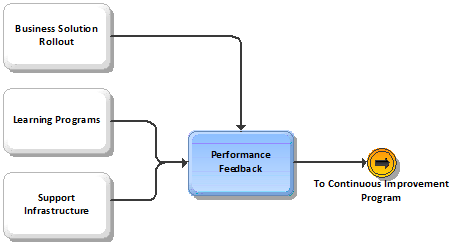
This deliverable should enable management to understand the overall impact of the BPI program on the organiza­tion's performance including the measures set with in the Business Case. Performance results tracked through the Measurement System should be communicated to the organization as part of the rewards and conse­quences of the implementation. Formal reward mechanisms may be included in changes to Performance Support and Recognition programs.
  1. Review performance information of newly implemented system.   
    1. Assess quantified performance measures for each major phase of the implementation. At minimum, these should include measurement of performance compared with the original Stretch Targets and other objectives for the BPI exercise.
    2. Performance results should be available from the Measurements Systems established or other infrastructure such as Help Desks, employee reviews, etc.   
  2. Analyze performance information and take appropriate actions.
    1. Ensure that root causes for the performance results obtained are fully understood so that lessons learned can be applied to the subsequent phases of the implementation. If Plateau Planning or a phased implementation approach is used, ensure that this learning and adjustment of future plans takes place at the end of each 'plateau' or phase. At this point, link to the Continuous Improvement Program to capture and communicate knowledge within the organization.    

Guidelines

Problems/Solutions

Tactics/Helpful Hints

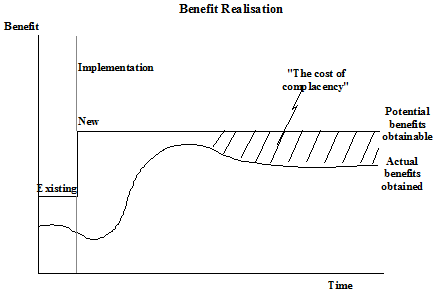
  • The figure below illustrates the realization of a typical benefit over time. Be aware that whenever any change is first implemented, there will be a learning curve during which users become familiar with the new environment and 'teething troubles' are resolved. The time taken to pass through this phase will vary depending on the magnitude of the changes introduced. Once this hurdle is overcome, benefits associated with the changes in behaviours required by the new
   
  • However, as time passes, the extent to which any potential benefits are realized can decline. This may be a result of changes in circumstances that are not reflected in the implementation of the “To-Be” state, poor provision of training and support after the implementation, reversion to old procedures etc. In some cases, organizations never realize benefits above those delivered by the existing environment for this very reason.

Resources/Timing

Monday, May 15, 2017

BPI Support Infrastructure – Implementation Phase

BPI Support Infrastructure – Implementation Phase

Description

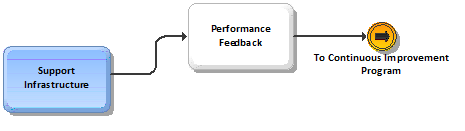
  • Development of the necessary support in all facets (workflow, technology, organization,     etc..) to enable the business solution after it has become operational in the organization.

Client Value

  • An adequate support infrastructure needs to be in place and functional during the Implementation phase to ensure that desired performance can be maintained after implementation is complete. Lack of a support infrastructure increases the likelihood that the performance in the organization will degrade over time through failure to address ongoing implementation issues and other hurdles that inevitably arise.

Approach

  1. Conduct interviews or workshops to determine the requirements for the Support Infrastructure   
    1. All systems require some continuing support and management. In some small systems, the arrangements are left undefined and informal. Although this may be practical in very small organizations, detailing the requirements of the support infrastructure in a formal way is often necessary to obtain resourcing.    
    2. Common forms of support/management include:       
      1. Reporting/resolution of 'bugs' in implemented IT solutions (internal/vendor)   
      2. Installation of upgrades of package IT solutions       
      3. Employee membership/participation in vendor user-group organizations   
      4. Management of system security, back-up, and disaster recovery policies           
      5. Creation and maintenance of a user 'help-desk' to answer employee questions pertaining to aspects of new business solution (e.g. policy changes)       
      6. Update/control of supporting documentation such as the Process/User's Manual or the Information Technology Operations Guide.   
      7. Monitoring of IT system performance and capacity   
      8. Archiving of system data   
      9. Maintenance/repair of physical assets (e.g. production machinery)   
      10. Acquisition of miscellaneous resources required for operation (e.g. paper, disks, toner cartridges, etc.)       
      11. Establishment of organizational appraisal and reward systems (e.g. suggestion boxes)       
      12. Communication mechanisms to provide feedback to personnel on system performance (e.g. company newsletters, electronic mail messages).   
  2. Define responsibilities and institute programs for the support infrastructure.   
    1. Ensure that responsibilities are unambiguous and they should be held by specified individuals or units. If certain support functions are provided in part by external organizations or are completely outsourced, take care to completely define the responsibilities of all parties concerned to avoid confusion with these external     relationships.       
    2. Consider various options for assigning internal responsibility for support functions (depending on the level of support required and the structure of the organization). The key questions that need to be answered are:
      1. Who will perform each support task?
      2. Who will manage support functions and be accountable for providing required services?
  3. In most cases, there are elements of both functional skills and technical skills required in the management, control and operation of the support infrastructure. Where the organization has a     specialist MIS department, try to involve them in the technical side of support and management. Recognize, however, that the overall management and control of the support infrastructure usually remains in the hands of the user-management to ensure service standards expected by customers of support functions are met.
  4. In some cases where new roles need to be created or where existing roles are changed substantially, obtain agreement on the organizational and staffing recommendations with senior management and/or the organization's personnel function.

Guidelines

Problems/Solutions


Tactics/Helpful Hints

  • In cases where required support functions cross organizational boundaries, ensure that management from all affected functions have been contacted and approve the defined support responsibilities. This will help to prevent possible future conflicts.

Resources and Timing