Monday, October 28, 2013

Sponsorship Role Map

Description


A graphical illustration, supported by clear role statements, of the accountability and relationships between project sponsors, as well as change agents, “targets” and advocates.

Business Value

  • \A Sponsorship Role Map clarifies and makes public the accountability of the key people within the organisation, and how they need to work together.  Sponsors need to understand their role and what it entails, and to ensure that change agents and “targets” (affected employees) know that they are ready to assume the sponsorship role.  It is critical that change agents and affected employees are convinced that the BPI sponsors truly support the change.  When this is the case, they are more likely to give their own commitment.
  • If the identified sponsor has neither the commitment nor the empowerment necessary to mobilise the organisation, the change will not be successful.  It is essential that this issue be faced early in the project and that actions be agreed to and taken to remedy the situation.

Approach

It is critically important for the project team and the organisation to understand the key roles in the change process.  These roles are as follows:s
  • Sponsor—the person or group who has the legitimate organisational accountability to effect change.  There is a useful distinction between initiating sponsors (the most senior person with direct accountability for the change) and sustaining sponsors (the network of leaders and managers who have accountability for one or more successive stages of the change).
  • Change agent—individuals or groups who are responsible for guiding or implementing change. Change agents who do not have the legitimate accountability to effect change cannot be sponsors; how­ever, sponsors may also act as agents.  Change agents include the project team as well as internal people.
  • Target—individuals or groups who must actually change the way that they work. Sponsors and agents may also be “targets” of a change.
  • Advocate—individuals or groups who support and champion change, but do not have the power to effect change.  Advocates may act and sound like sponsors; however, they do not have the power to actually make change.
Develop the Sponsorship Role Map in collaboration with the project sponsors and key internal change agents to foster a climate of open and honest communication between the project team and the organisation.
  1. Review the organisation chart to ensure that the project sponsor is in the line of legitimate authority.
  2. Identify of all key internal and external stakeholders, and clarify their roles.
    1. Roles include:
      1. Initiating or sustaining sponsors
      2. Change agents
      3. “Targets” of the change
      4. Advocates of the change.
  3. Discuss and resolve any problems or dilemmas associated with commitment levels, formal empowerment and competing priorities.
    1. This step can be dovetailed with the Stakeholder Analysis undertaken as part of the Communication Plan.
  4. Coach the leadership team on how they can best work together to support the initiating sponsor.
  5. Facilitate role plays about potential role conflict between sponsors (at various levels) and internal and external change agents.
  6. Present the Sponsorship Role Map to the wider senior management team.  Link this to the project management, performance management efforts and to the Case for Change. (Role Map Analysis)
  7. Develop an initial strategy for creating “buy-in” to the BPI initiative (and to the accountabilities of sponsorship) from those who will have to adopt a sponsorship role at some stage in the BPI exercise.
It is imperative that the client understands that the Sponsorship Role Map needs to be revisited and revised, as appropriate, at each phase of the BPI project, as well as within each of the Focus Areas.

Guidelines

Problems/Solutions

  • Certain configurations of roles result in significant problems in executing and implementing BPI.  For example:
    • Delegation of sponsor responsibilities to change agents—change agents can not be sponsors because they do not, by definition, have the power to legitimize or make change hap­pen within the target group.
    • Multiple and disjointed sponsorship of an individual process redesign—this will result in different target groups receiving different messages from their respective sponsors.  It can also result in the polarization of design teams.
    • Sponsorship “black holes”—these result when sponsors and change agents skip over one or more layers of middle managers in the process of effecting change.  This leads to the alienation of people who will, at some point, be required to actively support the implementation of change.
 Be aware of cultural and language barriers to the use of some terms, such as “targets”.  Acceptable synonyms are:
    • for “sponsor”
      • accountable leader
    • for “change agent”
      • change facilitator
    • for “targets”
      • affected employees; accountable employees
    • for “advocate”
      • champion; supporter; ambassador.

Tactics/Helpful Hints


  • Begin the role mapping with the key internal sponsor (sometimes called the initiating sponsor) and internal change agent (frequently the internal project manager). Recognize that an open and honest relationship with these people is a valuable asset.
  • Present a very clear role map of the consulting team, stressing in particular the accountabilities of people such as partners, engagement managers and principal consultants. You cannot expect role clarity from the client if there is no role clarity within the consulting team.
  • Carefully explain the difference between sponsors, agents, and “targets” of BPI.  Use this exercise as an opportunity to educate client personnel in these change management concepts.
  • Reassure individuals that their comments will be confidential.  People are unwilling to speak out or be critical if such assurances are not given.

Sunday, October 27, 2013

Readiness for Change Assessment

Description


  • An assessment of the ability of the business to undergo the organisational changes required to complete the BPI initiative successfully. This assessment profiles previous and current change efforts to identify:
    • Strengths or weaknesses of previous change efforts that need to be addressed in the design of  the  BPI program
    • Areas within the organisation that have experienced or are undergoing significant change
    • Areas within the organisation that have little or no experience with change
    • How the BPI program is similar to (or different from) previous changes in terms of its nature, scope and urgency
  • Based on this assessment, high level strategies are developed to avoid potential pitfalls and to manage the change process successfully.

Business Value

  • Previous experience with change is a good indicator of the ability to implement new processes. By analysing previous change efforts in a systematic way, it is possible to identify potential prob­lems and issues, and identify the effort required to achieve change successfully. This will also help to determine which areas of the organisation are the best candidates for pilot projects.
  • The risks for the client of not undertaking an assessment of organisational readiness for change at this stage in the BPI process include:
    • Pursuing a change strategy that is ill-suited to the change capacity of the organisation
    • Proceeding with a project that has no hope of succeeding.
Previous experience with change is an indicator of ability to implement new processes

Approach

The project team should begin to address the issue of change readiness in their first interactions with the Organisation.  This should then be built upon in management interviews, focus groups and through the use of relevant diagnostics.
  1. Conduct structured interviews with the Chief Executive Officer (or equivalent) and selected internal change agents to explore likely commitment and resistance levels within the organisation (including  within the leadership or top team).  Conduct a subsequent round of interviews with other key managers, to explore their feelings about the change, their level of commitment and their perception of resistance to change at all levels of the organisation.
  2. Identify all key change initiatives conducted in the last two to five years. Build upon the data gathered during the Internal organisational Overview in undertaking this step.
  3. Conduct focus groups or interviews of management and employees to identify and explore the reasons behind the successes and/or failures of past change initiatives. (Change History Diagnosis)
  4. Analyse results and develop report.
  5. The reports should include:
    1. Key potential problem areas and issues
    2. The location of groups with high change tolerance
    3. Ways to ensure previous implementation problems do not occur, or are minimised.

Guidelines

Problems/Solutions

  • Since confidentiality can be an issue for this deliverable, reassure individuals that their comments will remain confidential.  Identify the intended audience(s) for this information; as well as how it will be presented (e.g. summarised in aggregate form only).  Without this reassurance, respondents might otherwise be unwilling to speak out frankly about (or be critical of) previous change efforts.

Tactics/Helpful Hints

  • Stress the proactive nature of the assessment, and remind senior management that this review is being done to facilitate a smoother transition to new processes later on.
  • Generate concrete results (e.g. recommendations to move forward) to illustrate the value of the exercise.
  • Discuss previous change efforts with individuals at several levels of the organisation (staff, middle management, etc.) to gain a broad range of perspectives on previous changes.  Filter this information by attempting to validate it from multiple sources before presenting to the client, as well as by asking probing questions to ascertain the reasons behind individual perceptions.

Resources/Timing


  • Experience in conducting interviews and workshops addressing issues of a sensitive nature is required.

Holistic Business Model

Description


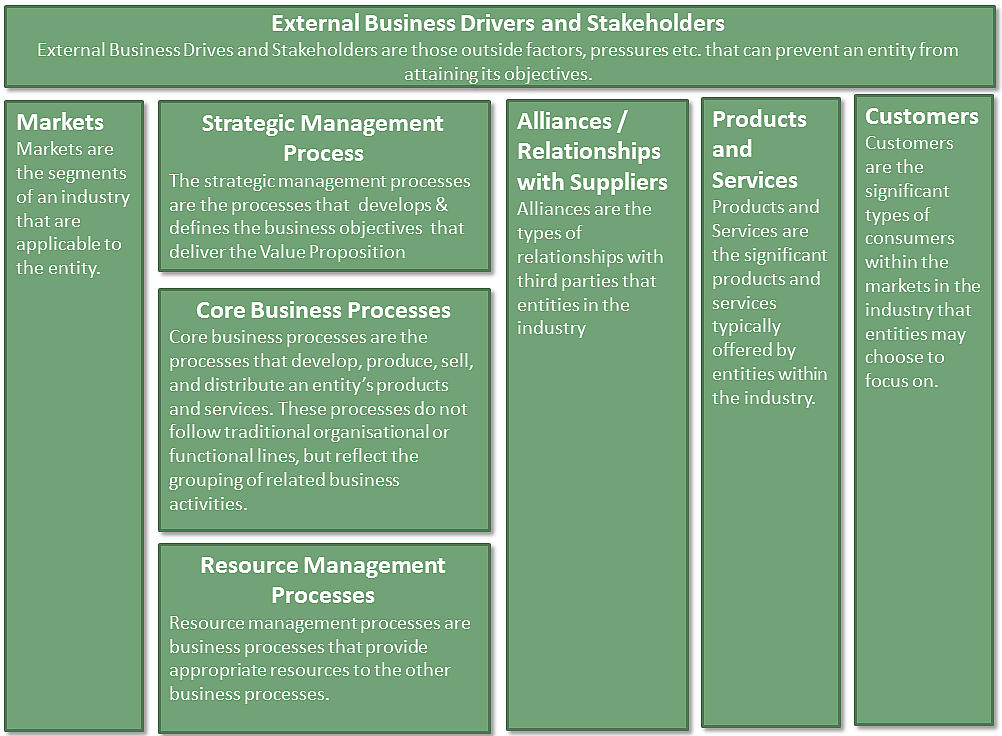
The Holistic Business Model is a (pictorial) synopsis portraying the interlinking activities conducted within an organisation as well as its external relationships.  This model depicts the Organisation’s entire business system in terms of markets, business processes, alliances and relationships, core services/products, customers and external forces.  It groups the Organisation’s internal functions into a set of interrelated, value-producing business processes and graphically depicts them within an Organisation and industry specific “value-chain” model.

Business Value

  • Senior managers typically have divergent perspectives on the key issues and areas of opportunity that characterise their business environment. The Holistic Business Model establishes a single, consistent frame of reference (context) and language around which specific business discussions occur.  It shifts people’s perspective of the organisation from a “functional” to a “process” oriented view .
  • The Holistic Business Model or Value Chain are key building blocks used in developing a (Confirmed) Business Vision and Focus Areas.  If these models are not developed, an Organisation’s management and staff will have difficulty grasping the notion that the organisation is comprised of “core and support processes which add value to a customer”—a cornerstone of BPI.

Approach

The Holistic Business Model serves to unify and confirm understanding of the Organisation’s business environment for organisation personnel and consultants alike.  It is a modeling technique that is easy-to-understand, can suit the Organisation’s industry/context and provides an appropriate level of detail for senior executives.
The diagram below establishes a standardised “Entity-level Business Model” (refer to diagram below) which serves as the starting point for business modeling. If more detail is required for each process the following information can be capture:
  1. Process Description
  2. Process Objectives
  3. Critical Success Factors (CSFs) liked to achieving the Business Process objectives
  4. Key Performance Indicators (KPI’s) linked to CFSs
  5. Process Inputs
  6. Process Key Activities
  7. Process Outputs
  8. Business Systems required to support the processes
  9. Data and information related to the process for use
  10. Risks that threaten the achievement of the Objectives
  11. Management Responses to the Risks i.e.the policies and procedures, which may or may not be put in place, that help provide assurance that the risks are reduced to an acceptable level
  12. Symptoms of Poor Performance Performance Improvement Observations


To focus further attention on the Organisation’s key business processes, consider also building a “Value Chain” model,  as a subset of the Holistic Business Model.  (Be aware that the “Value Chain” concept was originally developed by the renowned management theorist, Peter Drucker and that its use must be attributed appropriately.)
Initially identify and configure the Value Chain processes by stringing together the various functions of the organisation.  (Note that deciding which functions to string together, where to define “process boundaries” and what to name the resultant process often requires considerable reflection and creativity.)


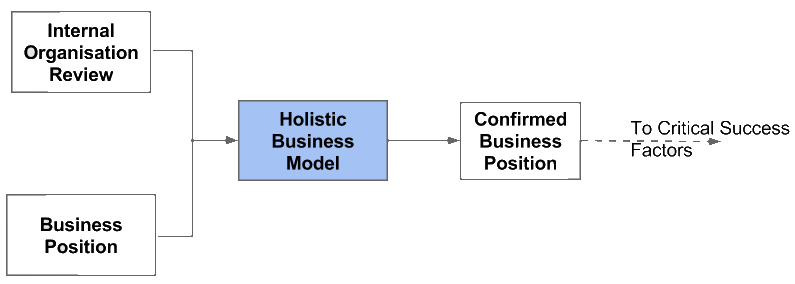
  1. Complete the Entity Level Business Model. Draw upon information gathered for the Internal organisational Overview and Business Position, as well as in interviews with executives.
  2. Determine secondary business modeling requirements.
  3. Select and develop secondary business model, if required. (Business Modeling)
  4. Develop the Value Chain for the organisation.  (Value Chain Analysis)
  5. Validate the Holistic Business Model(s) with senior management.

Guidelines

Problems/Solutions

  • Organisations (and even consultants) often will not recognize the value in this deliverable, and may not be willing to invest time developing and building consensus around the model.   In such circumstances, develop a “strawman” model, without Organisation input, and then relentlessly pursue senior management to validate and adopt it into their day-to-day thinking about the business.
  • Organisations will tend to describe their business in terms of departments, functions and the problems that exist.   Focus on processes and activities that add value to the Organisations products and services, not on organisational problems.  Be sure, however, to document any problems identified during this exercise for future deliverables.
  • Isolating and naming business processes can be both a creative and passionate activity.  Using conventional names is easier, but it will reflect the industry as a whole and not a value-chain specifically customized to address the nuances of how the Organisation views the  business (i.e. as drawn out of the Organisation through creative challenge and thinking sessions).  Always declare  the start and end points (or events) of a process first, then describe the things that happen between these two ends.  This will allow you to identify and group the various business functions/departments together into a final discrete process.
  • If it is too early to define processes to a very low detail at this time, delineate the entire business into not more than 15 major process names and 45 sub-components (the relationships between the 15 are valuable; the 45 are names only).

Tactics/Helpful Hints

  • View the business model as a portrait of the Organisation’s entire business system (markets, business processes, alliances and relationships, core services/products, customers and external forces).  View the Organisation’s Value Chain as a subset of the business model focused on the processes of the business.
  • The tactics of executing this deliverable are critical.  Throughout the BPI exercise, Organisation representatives are educated and trained to think of their business in a different and differently structured way.
  • This deliverable is first created in “strawman” form by the consultant alone (i.e. use audit personnel and knowledge base when audit Organisation) with some one-on-one discussions to collect and document knowledge about the Organisation and their business.
  • Creating this deliverable begins to build a business-focused relationship and credibility with the Organisation as well as the confidence of the consultant to speak to the Organisation on business terms (versus technical terms).
  • Multiple sessions (one-on-one or executive workshops) will be required to finalize the business model and value chain;  start with a high level model (entity level) add more detailed models if greater clarity and visual aids are needed to adequately focus, describe or talk about business issues with the Organisation
  • Selection of a modeling technique should be based on what the Organisation team can understand, comprehend and sees as valuable.  Utilize simple frameworks (i.e.  solely to communicate understanding); use the type of  business model that will be the most easily understood in the organisation .
  • The greatest impact of the Holistic Business Model and Value Chain is when they become a continuously referenced tool among Organisation and consultant during discussions about the business, the BPI Program, the scope and areas for improvement;  having such common ground provides clarity of process boundaries, scope of projects, expected benefits, results and costs

Resources/Timing


  • Set concrete time limits for the completion of this business model.  The consultant needs to recognize when to stop adding detail or refining the model. The Organisation team should understand at the beginning of this task that the model is a starting point for other activities, and that the scope and definition of business processes will probably be refined and modified in later steps.
  • Senior management workshop facilitation skills are required along with verbal and written communication skills, including interviewing and presentations; ability to work with Organisation personnel at multiple levels of the organisation
  • Organisation staff involvement may be extensive, depending on the size, complexity and detail of the busi­ness model selected.  This involvement may include participation in workshops, individual inter­views, and validation of the interpretation of the process relationships.
  • Senior executives and management must have ownership of this model; when they are passionately engaged they will find it insightful and eye-opening;  the responsibility is on the project team to spend one-on-one time with executives to evoke the passion, interest  and recognition of the value of this deliverable.

Saturday, October 26, 2013

Business Position

Description

An external “snapshot” of the client organisation’s business performance relative to its position in the marketplace.  This assessment identifies the organisation’s strengths/weaknesses/opportunities for growth and reviews the organisation’s performance relative to direct competitors and industry leaders.

Client Value

  • The creation of subsequent deliverables (e.g. (Confirmed) Business Vision, Critical Success Factors, and Stretch Targets) requires an understanding of the key issues dominating the competitive environment in which the client is working.
  • The team will be educated on the company’s performance relative to close competitors and/or other industry leaders.
  • This deliverable helps to solidify the Case for Change by highlighting both the urgency and the magnitude of the required transformation.
  • Not understanding the Business Position of the organisation can lead to the development of short-sighted Critical Success Factors and Stretch Targets that do not result in longer-term improvements (such as increases in sales and sustained growth in market share).

Approach

The information provided in the Internal Organisational Overview is combined with information from external sources to compare and contrast the client’s business vis-à-vis its major competitors and the marketplace in general. The resulting analysis will pinpoint the organisations strengths, as well as issues to be addressed if the client wants to improve its market position.
  1. Collect and review documentation.
    1. Review information gathered from literature searches, organisation documents and materials on the client and key industry issues.
    2. Gather any additional information needed for external analysis.
  2. Analyse key performance information .
    1. Analyse external and/or internal performance in terms of efficiency, effectiveness, growth, quality, inventory management, customer service, etc.
    2. Research/Access available data on competitor/industry performance statistics (Benchmarking).
    3. Summarise  potential performance comparisons.
    4. Construct preliminary comparisons to other operating divisions and/or competitive/industry data.
  3. Assess positioning in marketplace.
    1. Review organisation’s performance.
    2. Itemise internal constraints and external market trends.
    3. Assess high-level competitive advantages/disadvantages.
    4. Summarise  findings into high-level position assessment that identifies market share, profit contribution and the current delivery strategy.
  4. Share/confirm major findings with client.

Guidelines

Problems/Solutions

  • Use information that is readily available, without spending too much time searching for hard-to-find information.

Tactics/Helpful Hints


  • Leverage industry expertise and benchmarking resources to provide value to organisation; this exercise represents an opportunity to enhance the credibility and demonstrate value early in the BPI effort.
  • Have some understanding of key performance indicators for the industry and for the client in particular so that competitive analysis that is done will have some relevance/ value to the client.
  • In addition to current business position, analysis should identify (at a high level) future industry trends and assess how internal strengths and weaknesses position the client to take advantage of these future trends.