Monday, January 6, 2014

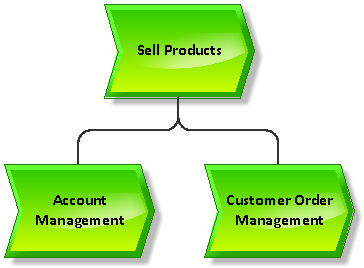
Core Business Processes - Sell Products


Description

This process manages the entity’s customers and the interaction with them.

Sub Process Components


Account Management

Process Objectives

  1. Maximise profitable sales
  2. Ensure all sales opportunities are realised
  3. Maintain appropriate in-store presence
  4. Seek collaborative development opportunities
  5. Establish points of differentiation vs competitors

Critical Success Factors (CSF’s)

  1. Quality of account sales managers (1,2,3)
  2. Acceptance of trade programmes (1,3,4)
  3. Clear understanding of customers current needs and   future strategy (1,3,5)

Key Performance Indicators (KPI’s) Linked to CSF’s

  • Net sales per salesperson; customer profitability (A)
  • Trade promotion spending (B)
  • Customer satisfaction survey results (C)

Inputs

  • Understanding account strategies
  • Customer profitability
  • Advertising and promotion plans
  • Customer service objectives
  • Marketing plan
  • Trading terms
  • Trade marketing plans
  • New product development strategy
  • Competitor research
  • Market research
  • Distribution objectives

Activities

Outputs

  • Investment priorities
  • Agreed account budget in terms of sales and profit
  • Promotion plan
  • Strong business relationship

Systems

  • Decision support systems
  • Executive information system
  • Budget planning system
  • Customer databases

Classes of Transactions

Routine
Non-Routine
Accounting Estimates

Risks Which Threaten Objectives

  1. Poor communication with customers (2,4)
  2. Rejection of trade programmes (2,3,4)
  3. Better perception of competitors by customer (5)
  4. Poor customer service (1,2)
  5. Unwillingness to pursue alliances (4)
  6. Lack of gross profit by customer/product line information (1)

Management Responses Linked to Risks

  • Regular feedback from customers (A,D)
  • Comprehensive category and market analysis (B,E)
  • Monitoring of competitors trade programmes (C)
  • Maintain strong customer service department (D)
  • Providing gross profit by customer/product line
  • Information to account sales managers (F)

Other Symptoms of Poor Performance

  • Account managers have no responsibility for profit
  • No central coordination of account managers
  • Large number of credit queries

Performance Improvement Observations

  • Sales force automation
  • “Best practice" promotions
  • Category management
  • Customer / competitive analysis
  • Analysis of trade programme performance
  • Cost-to-service analysis

Customer Order Management

Process Objectives

  1. Communicate product demand to distribution
  2. Establish warehouse, transport, invoice cycle
  3. Confirm price and delivery terms

Critical Success Factors (CSF’s)

  1. Efficient and accurate entry of customer orders into system (1)
  2. Accurate product pricing, promotions database (3)
  3. Efficient communications links in responding to customer issues (1,3)
  4. Effective, integrated IT system that is easily understood executed by employees (2)

Key Performance Indicators (KPI’s) Linked to CSF’s

  • Percentage of orders accepted via EDI; customer order error rate (A,D)
  • Number of deductions, credit notes (B)
  • Number of unresolved customer issues (C)
  • Order to delivery time (D)

Inputs

  • Finished goods availability
  • Distribution schedules
  • Customer order
  • Customer details (delivery address, credit limits, etc.)
  • Pricing and terms detail

Activities

Outputs

  • Order picking details for distribution
  • Invoice to customer
  • Sales order statistics

Classes of Transactions

Routine

  • Sell products
  • Invoicing customers
  • Receive payments
  • Accrual of rebates
Non-Routine

  • Unusual collection problems
  • Sales of accounts receivable
Accounting Estimates

  • Reserve for bad debts
  • Reserve for product returns

Risks Which Threaten Objectives

  1. Inaccurate order entry (1)
  2. Poor internal communication (1,2)
  3. High level of deductions; unresolved customer order / invoice issues (3)

Management Responses Linked to Risks


  • Efficient order entry procedures (for example, EDI) (A)
  • Use of integrated systems for order management (order entry, inventory management, logistics / transportation) (B)
  • Simplified pricing / promotion policies; single point of contact for customer regardless of issue (C)

Other Symptoms of Poor Performance


  • High activity levels involved in sales order processing
  • Long time-span between receipt of customer order and dispatch


  • Performance Improvement Observations

    • Sales force automation
    • Activity-based costing (cost-to-serve analysis)
    • Business process re-engineering
    • Foreign sales corporation tax planning
    Enterprise package software implementation

    Friday, January 3, 2014

    Core Business Processes - Manage Product Portfolio

    Description


    This process manages the portfolio of products offered by the entity and develops new products or improves existing products as markets and customers needs change.

    Sub Process Components

    Portfolio / Brand Management

    Process Objectives

    1. Focused product portfolio
    2. Growth opportunities
    3. Increased share of market
    4. Product differentiation (brands)
    5. Increased sales (volume and value)

    Critical Success Factors (CSF’s)

    1. Development of product/brand recognition  (1,2,3,4,5)
    2. Maintenance of retail customer support (3,4,5)
    3. Promotion/deal effectiveness (3,4,5)
    4. Awareness of products with the most potential for increasing sales (1,2,3,5)

    Key Performance Indicators (KPI’s) Linked to CSF’s

    • Promotional spending, market share (A)
    • Trade spending/customer paid promotions (B,C)
    • Incremental net revenue; incremental market share; promotional redemption vs category norms (A,C,D)

    Inputs

    • Strategic plan
    • Operational constraints
    • Consumer / customer research
    • Market research
    • Competitor research
    • Self-assessment of strengths / weaknesses
    • Current and past sales and market share

    Activities

    Outputs
    • Product pricing
    • Projected market share

  • Advertising and promotion plans
  • Timing plan for evolution of portfolio

  • Budgeted sales and profit
  • Systems

    • Customer / marketing database
    • Materials, packaging specifications and costs

  • Budgeting and forecasting systems

  • Executive information systems
  • Classes of Transactions

    Routine
    • Advertising (brands)
    • Promotional / direct marketing costs
    Non-Routine
    • Barter transactions
    Accounting Estimates
    • Accruals (coupons, mailers, displays)
    • Deferred promotions
    • Intangible assets (brands)

    Risks Which Threaten Objectives

    1. Noncompetitive pricing (3,5)
    2. Low brand awareness (brands) (2,3,5)
    3. Ineffective promotion (brands) (2,3,5)
    4. Lack of vision/description when assembling portfolio (1)
    5. Lack of creative product development team that understands market (4)

    Management Responses Linked to Risks

    • Monitor sales gains, losses and competitor activity (A,D)
    • Regular consumer research and dialogue (A,B,C,D,E)
    • Tracking of promotion/advertising results (A,B,C,D)

    Other Symptoms of Poor Performance

    • Long trail of low volume, low profits

  • Low redemption of consumer promotions

  • Overlap of product positioning
  • Performance Improvement Observations

    • Promotional effectiveness analysis
    • Promotional modeling

  • Database marketing
  • Accounting method review

  • Executive information systems
  • Strategic review of brands (positioning, pricing)
  • New Product Development

    Process Objectives

    1. Improve sales and profit
    2. Deliver customer satisfaction
    3. Refresh product mix
    4. Expand existing market

    Critical Success Factors (CSF’s)

    1. Effective use of market research (1,2,3,4)
    2. Ability to respond quickly to market opportunities or   competitive threats (1,3)
    3. Meeting consumer/customer requirements on price and performance of new products (1,2,3,4)
    4. Effective use of all resources dedicated to introducing new products (1,3)

    Key Performance Indicators (KPI’s) Linked to CSF’s

    • Internal failure rate; impact of internal failures (A,D)
    • Product development cycle time (B)
    • Percentage of revenue from new products; market share of new products (B,C,D)
    • Introduction return on investment (D)

    Inputs

    • Market research
    • Packaging / production research
    • Strategic plan
    • Timeplan of evolution of portfolio
    • Consumer research
    • Competitor information
    • Supply chain
    • Customer research
    • ·   Production facilities

    Activities

    Outputs
    • New products
    • Budgeted sales, costs, profit

  • Advertising / promotion / public relations
  • Product designs / specifications

  • Projected market share
  • Material, facilities and resource requirements
  • Systems

    • Customer database

  • Market research database
    • Product / research and development databases

    Classes of Transactions

    Routine
    • Costs for designing and developing prototypes, including wage costs and capital additions
    Non-Routine
    • Third-party alliances / royalty arrangements
    • Research and development funding arrangements
    Accounting Estimates
    • Reserve for obsolete products

    Risks Which Threaten Objectives

    1. Too slow to market with new products (1,3,4)
    2. Failure to get trial of new products (1,3)
    3. Failure to get sustained sales of new products (1,2,3,4)

    Management Responses Linked to Risks

    • Use of cross-functional teams to ensure accurate product costing, manufacturability and customer/consumer acceptance (A,B,C)
    • Obtain feedback from customers/consumers to advertising and promotional concepts (B,C)
    • Approval of market research, product development and product introduction plans by senior management (A,C)

    Other Symptoms of Poor Performance

    • Low production efficiencies
    • New products only cannibalise own business

  • New products are copies of other products

  • Inability to service marketplace
  • Performance Improvement Observations

    • Competitive market and product analysis
    • Research and experimentation credit analysis

  • Product development design process
  • Capitalisation review

  • Cost re-structuring, re-allocation

  • Wednesday, January 1, 2014

    The Holistic Business Model - Core Business Processes


    The Consumer Products Model is structured in a simplified supply chain format, with six core processes, four of which are subdivided into two sub-processes.
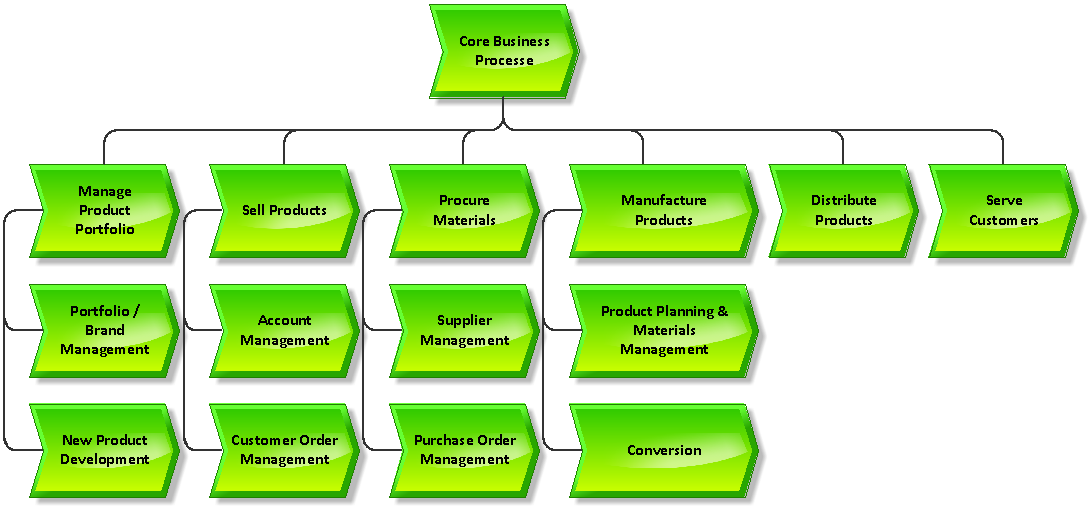
    Consumer Products Manufacturer - Core Business Processes

    The linear nature of the graphics should not imply that these processes always take place sequentially.  Indeed many of the activities detailed within the model occur on a continuous basis, with many operating in parallel.  The model is designed to provide examples, at a high level, of the activities you are likely to find in a consumer products company.  The way in which that company operates will of course be unique, and you will need to understand, and be able to group, their specific processes in a way which is relevant to the company.
    The selling process is placed towards the front of the model for a specific reason.  Although the activities of receiving a customer’s order, assembling and delivering the goods, and invoicing the customer, will often take place towards the end of the chain, the selling process itself, is continuous, focused on good customer account management.  As more consumer products manufacturers improve their flexibility and responsiveness to their customers, the ultimate goal, of making to-order, becomes more relevant.  Putting selling at the front of the manufacturer’s supply chain, emphasises this fundamental shift, from producing for-stock, towards producing to-meet demand.
    The Core Business Processes and Subprocesses will be further expanded upon by subsequent BLOGS. I must emphasise that this is a generic Consumer Products Business Model which can serve as the basis for customising a specific companies Core Processesl.